

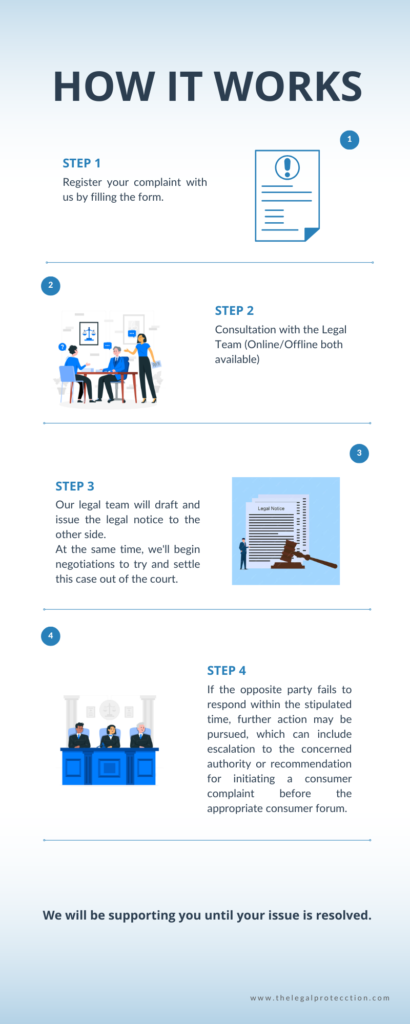


What is Consumer Complaint ?
A consumer complaint represents a formal grievance filed by a purchaser expressing dissatisfaction with a product or service they have acquired. Common issues that trigger such complaints include:
1. Broken or damaged products
2. Poor quality service
3. Dishonest or misleading business practices
4. Overcharging or wrong billing
5. Late deliveries
Consumer Protection Act
According to the Consumer Protection Act, originally established in 1986 and revised in 2019, any individual who purchases goods or services (whether paid in full, partially, or on credit) qualifies as a “consumer.” As a consumer, you possess the legal right to lodge complaints with vendors, service providers, or regulatory bodies to obtain remedies such as refunds, product replacements, or monetary compensation.
Purchase Channels Coverage
These protections extend to purchases made through various channels including retail stores, e-commerce platforms, telephone orders, telemarketing campaigns, and direct sales.
About Consumer Protection Act
The Consumer Protection Act, 2019 is a comprehensive law designed to safeguard the rights of consumers in India. It replaces the previous Consumer Protection Act, 1986, and introduces several key changes to address modern challenges, including the rise of e-commerce and the digital marketplace.
Below are the main features of the Act:
1. Consumer Rights
Right to be informed: Consumers have the right to know the quality, quantity, price, and essential details of goods and services.
Right to safety: Protection from goods and services hazardous to life and health.
Right to choose: Access to a variety of goods and services at competitive prices.
Right to be heard: File complaints and express concerns regarding goods and services.
Right to seek redressal: Legal remedies for harm or loss caused by defective goods or deficient services.
2. Central Consumer Protection Authority (CCPA)
The Act establishes the CCPA, which has broad powers to:
Investigate unfair trade practices and deceptive advertisements.
Recall unsafe products or discontinue unsafe services.
File complaints on behalf of consumers to enforce their rights.
3. Consumer Disputes Redressal Commissions
The Act sets up commissions at three levels to resolve disputes:
District Commission: Claims up to ₹1 crore.
State Commission: Claims between ₹1 crore and ₹10 crore.
National Commission: Claims exceeding ₹10 crore.
4. Simplified Grievance Redressal
Consumers can file complaints online via the National Consumer Helpline and Consumer Protection Portal.
Disputes must be resolved within 3 months (with an optional extension of 3 months).
5. Unfair Trade Practices
Penalties for misleading advertisements.
Accountability for defective products and substandard services.
Provisions for regulating e-commerce platforms and ensuring transparency.
6. Product Liability
Manufacturers, sellers, and service providers are responsible for harm caused by defective goods or deficient services. Consumers can claim compensation for such injuries.
7. E-Commerce and Direct Selling
The Act regulates e-commerce platforms, ensuring:
- Mandatory grievance officers and redressal mechanisms.
- Transparency in seller information, product details, and refund/return policies.
8. Penalties and Enforcement
The Act allows consumer forums to impose penalties, including:
- Fines and imprisonment for unfair trade practices.
- Compensation for consumers harmed by defective products or services.
9. Class Action Suits
Consumers facing similar issues can file class action suits to collectively seek redressal.
10. Consumer Protection Councils
The Act establishes State and District Consumer Protection Councils to promote consumer awareness and advise the government on consumer-related matters.
11. Regulation of False Advertising
False or misleading advertisements, particularly those concerning health and safety, are prohibited. The CCPA can take action against violators.
12. Redressal Mechanism for E-Commerce
- Mandatory complaint redressal systems for e-commerce businesses.
- Clear return and refund policies for timely resolution of consumer grievances.
13. Strengthened Consumer Rights for Vulnerable Groups
The Act emphasizes protecting vulnerable groups like senior citizens, women, and children from exploitation.
Conclusion
The Consumer Protection Act, 2019 strengthens consumer rights in India by introducing mechanisms for quicker dispute resolution, penalties for violations, and e-commerce regulation. With the establishment of the CCPA and consumer forums, it ensures effective protection and redressal for all consumers.
Consumer Complaint Categories












Cases Successfully Resolved
Densil vs Success Engineering
Amount
₹1,20,000Suresh vs Star Health Insurance
Amount
₹4,48,000Ritesh vs Sankara Eye Hospital
Amount
₹30,068Prem vs Layers Clinic
Amount
₹91,000Krishna vs The Custom Motors Club
Amount
₹9,15,000Rahul vs Planet Spark